Play Therapy at Home: Simple Strategies to Help Your Child with ADHD Build Focus and Self-Regulation
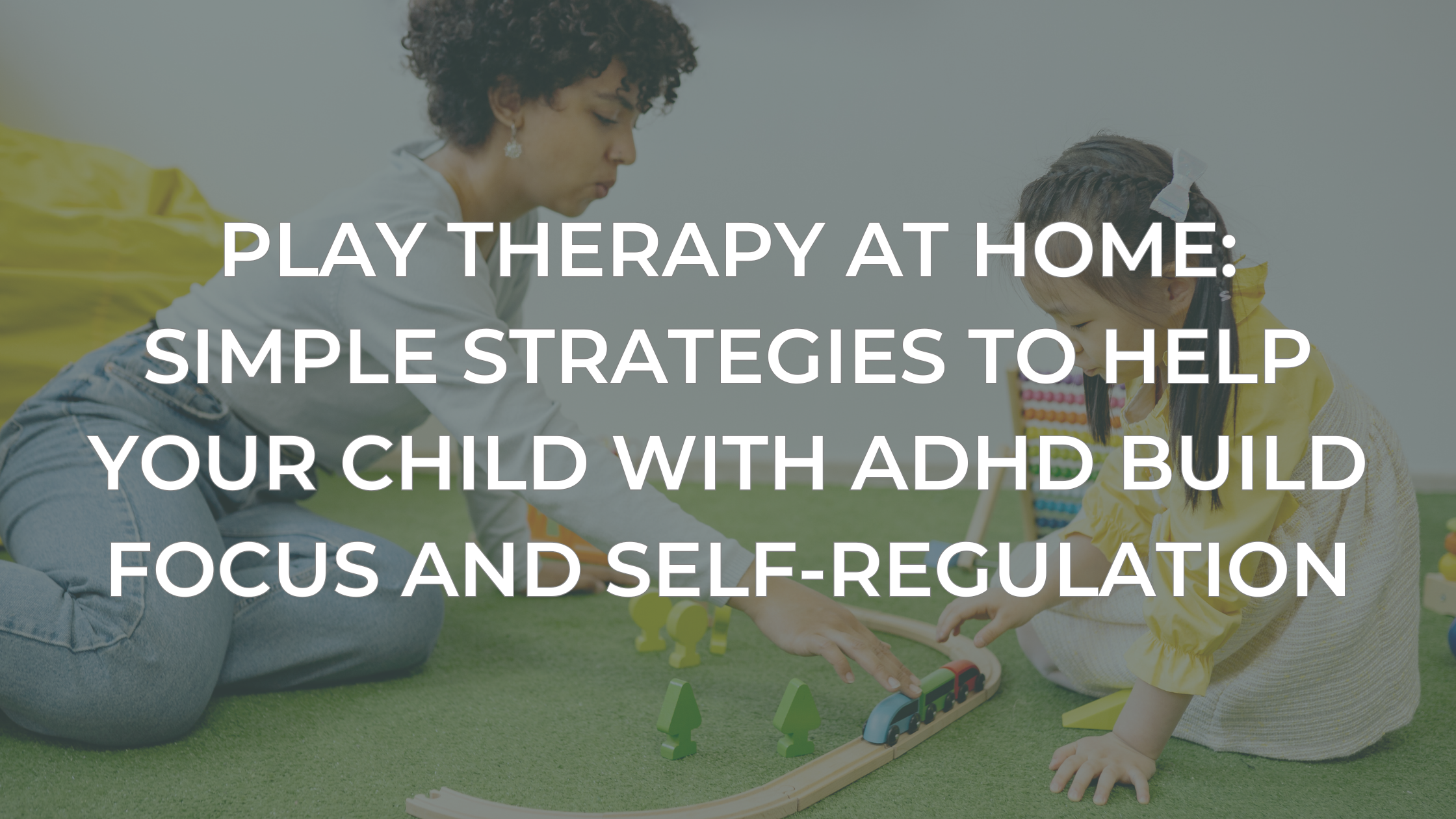
Here are play therapy-informed strategies parents can use at home to help kids with ADHD build focus, self-regulation, and impulse control — through play rather than lectures or corrections.
1. Follow their lead (child-directed play)
Set aside 10-15 minutes a day where your child picks the activity and you simply narrate and join in — no questions, no directions, no correcting. This "special time" builds connection and gives your child practice staying engaged in one activity, which strengthens the same attention muscles they need elsewhere.
2. Narrate instead of instructing
Instead of asking questions or giving directions during play, describe what your child is doing: "You're stacking the blocks really carefully." This keeps them in the activity longer and models sustained attention without pulling them out of the moment to respond to you.
3. Use "stop and go" games for impulse control
Red Light/Green Light, Freeze Dance, or Simon Says are play-based ways to practice inhibiting impulses in a fun, low-stakes setting. The more a child practices "pausing" in play, the more that skill generalizes to real-life moments — waiting their turn, not blurting out.
4. Turn transitions into games
Instead of "put your toys away now," try "let's see how many toys we can put away before the timer buzzer." Gamifying transitions reduces the friction that often triggers meltdowns for kids with ADHD.
5. Give big, physical play regularly
Obstacle courses, pillow forts, animal-walk races — big movement play helps regulate the nervous system and often makes it easier for a child to sit and focus afterward. Think of it as "spending" excess energy productively rather than trying to suppress it.
6. Practice waiting through turn-taking games
Simple board games or card games (Candy Land, Uno, Go Fish) build the skill of waiting for a turn in a way that feels like play instead of a demand. Keep games short at first — a few rounds is a win.
7. Use pretend play to practice "what if" scenarios
Acting out scenarios with stuffed animals or figures — like a character getting frustrated and taking a breath, or waiting patiently — lets your child rehearse regulation skills in a low-pressure context before they need them in real life.
8. Let them "win" some frustration tolerance in small doses
Games with a little unpredictability (a spinner, a die) give natural, low-stakes chances to practice handling disappointment. Stay calm and narrate through it: "Aw, you didn't get the number you wanted — that's frustrating. Let's try again."
9. Keep sessions short and success-focused
Attention spans in young kids with ADHD are often shorter, so aim for brief bursts of focused play rather than long stretches. Ending on a positive note (even if you cut it short) builds a positive association with focused activities.
None of this needs to be perfect or clinical — the goal is connection first, skill-building second. And if you're noticing that home strategies aren't quite enough, or you'd like guidance tailored to your child specifically, that's exactly what therapy is for.
We're here to help.
Meet Our Team
Dr. Norma Reyes, LPC-S
Dr. Norma Reyes is a Licensed Professional Counselor and Supervisor and founder of Pathway to Inner Healing Counseling. She specializes in supporting high-achieving women, working moms, and individuals experiencing anxiety, burnout, and life transitions. Her approach is warm, collaborative, and grounded in helping clients reconnect with themselves while breaking generational patterns and stress cycles.
Elizabeth Vela, MS, LPC-Associate
Elizabeth Vela is a bilingual therapist (English and Spanish) who works with children (4+), teens, adults, and families. She provides a supportive and culturally responsive space for clients navigating anxiety, stress, life transitions, and relational challenges. Elizabeth integrates CBT, Solution-Focused Therapy, and Narrative Therapy to help clients build insight, coping skills, and emotional balance.
Elizabeth practices under the supervision of Dr. Norma Reyes, LPC-S.
Ready to Begin Therapy?
If you’re exhausted from overthinking, constantly carrying pressure, or feeling like you always have to “keep it together,” therapy can help.
You deserve support, rest, and space to breathe.
You can schedule an appointment with our team here: Click here to schedule.
We’re here when you’re ready.
Disclaimer & Crisis Support
This blog is for informational purposes only and is not a substitute for professional mental health treatment, diagnosis, or emergency care.
If you are experiencing a mental health crisis or feel you may be in danger of harming yourself or others, please seek immediate support:
Call or text 988 to reach the Suicide & Crisis Lifeline (available 24/7 in the U.S.)
Or go to your nearest emergency room
If you are outside the U.S., please contact your local emergency services
