Breaking Generational Cycles Without Breaking Your Family: A Guide for Latina Women
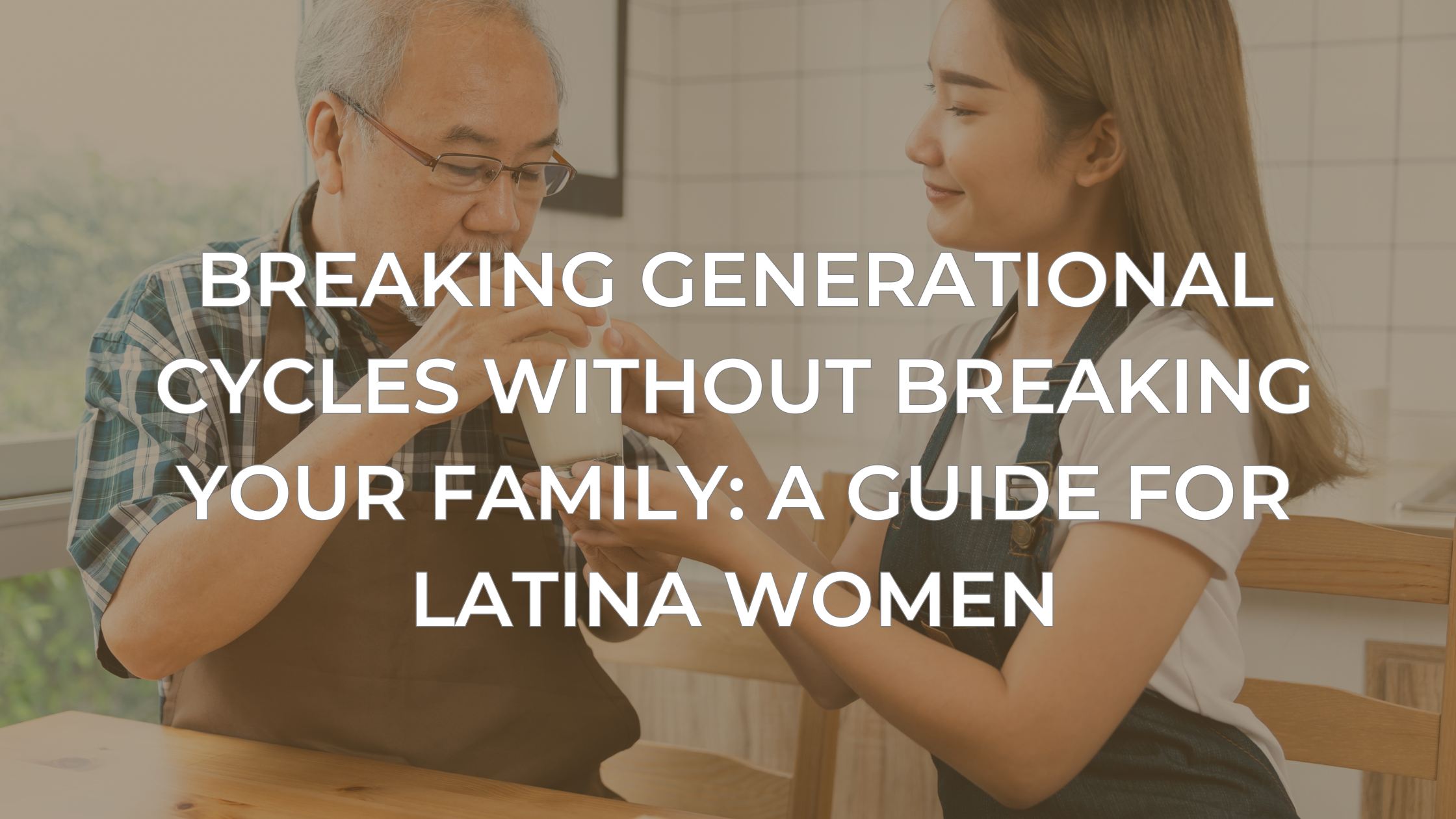
The Lunch Break That Wasn't: On Being the "Tech Support" for Our Parents
Today, I spent most of my lunch hour helping my dad figure out what was wrong with his phone. He couldn't receive or make calls, couldn't access the internet — nothing was working.
I had actually started my Monday well. I took time for myself. I had my sessions. I started my lunch break watering my plants, looking forward to resting after spending about fifteen minutes outside in the 100+ degree sun.
Then I walked back in and saw a call from "la Amiga" — my dad's current partner. My stomach dropped. My dad is 67. He's been having blood pressure and heart issues. Two missed calls. My mind went straight to something is wrong.
It wasn't a medical emergency, thank God. It was his phone. We tried a few things. Text messaging started working again. And then, after a lot of troubleshooting through facetime (I’m so glad his ‘Amiga’ has an iphone since my dad has a Samsung), it finally dawned on me to reset the SIM card. Boom. Done.
And then it was time to get back to sessions.
This — this — is the struggle of being both the child of immigrants and a middle-aged adult, where so much is pulling at you at once, and your own needs quietly go to the back of the line.
The Weight Nobody Talks About
If you're reading this and nodding along, you probably know this feeling in your body before you can even name it. It's the stomach-drop when your parent's name flashes on your screen. It's being the designated translator, the tech support, the appointment-scheduler, the one who explains what the doctor "really" meant. It's loving your parents fiercely and feeling stretched thin by the role you've stepped into, often without ever being asked if you wanted it.
For so many of us who are children of Spanish-speaking immigrant parents, this role starts young. We grew up translating at the bank, at parent-teacher conferences, at the pharmacy. Now, decades later, the assignment has just changed shape — SIM cards instead of school forms, but the same underlying expectation: you'll figure it out, you always do.
And we do. But it costs something. And that cost deserves to be named, not just absorbed.
Coping Strategies for the In-Between Generation
1. Let the panic pass through you before you problem-solve. That stomach-drop moment is real fear, not an overreaction. Give it a few seconds to move through your body — a breath, a hand on your chest — before you jump into fix-it mode. You're allowed to feel scared and still be capable.
2. Build a "tech triage" script for yourself. Half the stress of these moments is not knowing where to start. Keep a simple mental (or written) checklist: restart the phone, check for a carrier outage, reset the SIM, check for app updates. Having a script lowers the emotional load of the unknown.
3. Protect the pause, even when it gets interrupted. Your fifteen minutes with your plants still counted, even though it got cut short. Don't let an interrupted moment of rest convince you that rest doesn't work for you. It does. Keep taking it in whatever form you can get it.
4. Name the dual role out loud. "I am someone's daughter/son and someone's therapist/provider/professional today, in the same hour." Saying this to yourself — or to a friend, a partner, a therapist — takes it out of your body and gives it language. Unnamed stress tends to just sit and simmer.
5. Find the humor when you can. Laughing about the SIM card saga afterward isn't minimizing it — it's a nervous system's way of finishing the stress cycle. If you can find the humor, let yourself have it.
6. Set a "re-entry" ritual before your next task. Even sixty seconds — washing your hands, taking three slow breaths, stepping outside again — helps your body know one chapter closed before the next one (sessions, a meeting, dinner) begins.
Why Processing and Venting Actually Matter
It can be tempting to brush moments like this off — it wasn't even a real emergency, why am I still thinking about it? But your nervous system doesn't know the difference between "almost" and "actually" until you help it catch up. That fear was real in your body even after the facts turned out okay.
Talking about it — with a friend, a partner, a journal, or a therapist — isn't dwelling. It's how the stress actually finishes its cycle instead of quietly stacking on top of the last time, and the time before that. Venting isn't weakness or complaining; it's maintenance. It's how caregivers, professionals, and children of immigrants stay whole instead of just staying functional.
You Are Not Alone in This
If your Mondays sometimes look like mine — sessions, self-care, and suddenly SIM cards, all before 1pm — I want you to hear this clearly: you are not failing, and you are not alone.
So many of us are holding down careers, caring for our own families, and still being the first call when a parent's phone stops working, a form needs translating, or a doctor's note needs explaining. That's not a personal shortcoming. That's the very real, very heavy inheritance of being la generación del medio — the middle generation, holding both ends.
You're allowed to be tired. You're allowed to need support, too. You don't have to carry all of this in silence, and you don't have to figure out how to hold it all by yourself.
If this resonated with you, we’d love to help you carry some of it.
Book a session and let's talk about what it's really like to be the strong one — and find some space for you to be taken care of too.
Disclaimer & Crisis Support
This blog is for informational purposes only and is not a substitute for professional mental health treatment, diagnosis, or emergency care.
If you are experiencing a mental health crisis or feel you may be in danger of harming yourself or others, please seek immediate support:
Call or text 988 to reach the Suicide & Crisis Lifeline (available 24/7 in the U.S.)
Or go to your nearest emergency room
If you are outside the U.S., please contact your local emergency services
